← BLOGengineering5 min read 4 articles reference this — jump to the list
Why This Website Is a Living System
AI is the leverage. The will behind it is what makes the software behave like an organism instead of a brochure.
CONTENTS3 SECTIONS
Most of the web is built from dead matter. Pages are assembled, frozen, and shipped. They may animate — a gradient drifts, a badge pulses — but the animation is a recording, not a behaviour. Nothing on the page responds; it only replays.
RED MAGIC began as a question about that difference. What would it cost, technically, to make a page that behaves instead of replays? Not a video of a living thing. Not a looping decoration. An actual simulation whose observable state changes because you moved through its field. This article is the 2026 edition of the answer — because the cost curve changed this year, and the change is the point.
An organism, not a widget
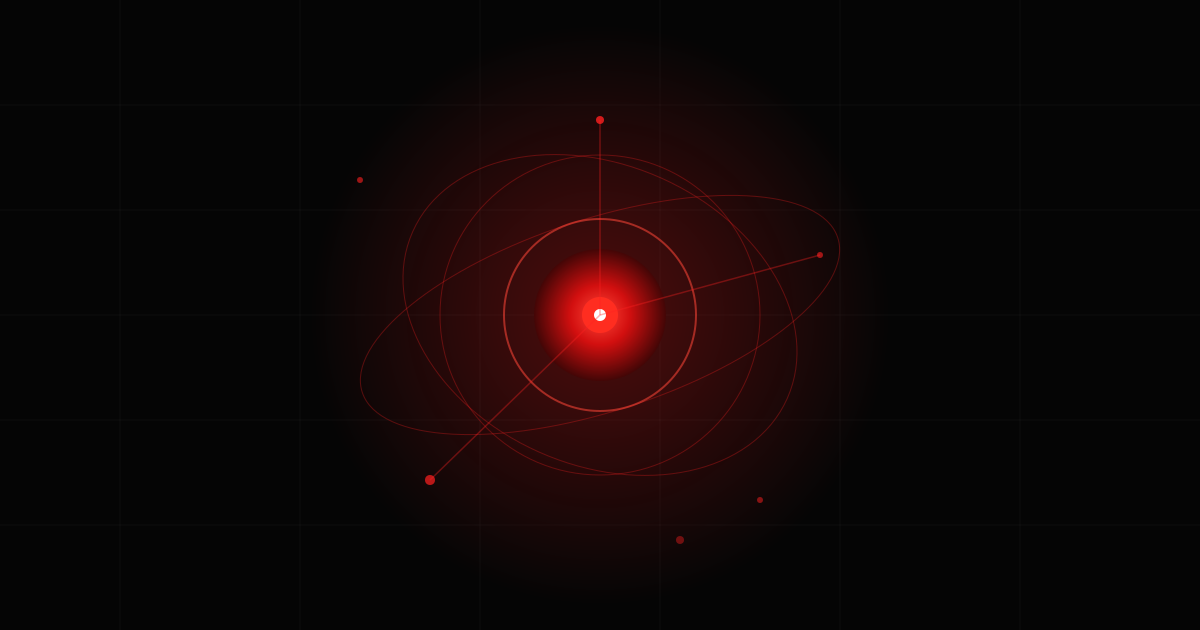
The organism you can run in the MAGIC laboratory has five layers: a core that pulses, a membrane that reaches toward your pointer, energy flows between them, orbiting particles, and a signal layer — which is you. Every layer is computed live. When the membrane swells toward your cursor, that is the simulation integrating your movement, not a CSS transition pretending to.
The same principle runs at ambient scale through the whole site: one continuous background organism with layered timescales — particles and sparks on micro loops, wisps and rings on short and medium loops, atmospheric masses on long loops, and a heartbeat underneath. As of this upgrade the layers are phase-de-synchronised (no layer starts at zero on load), coupled to a shared energy signal, and echoed by a resonance ring that only becomes visible when the organism is awake. Move, and the entire field brightens as one system. Stop, and it settles to silence at zero JavaScript cost.
The interesting engineering constraint is what happens next. A naive implementation of this idea costs you the page. Canvas loops, per-frame allocations, unbounded particle counts — the classic mistakes make an interface that looks alive and feels dead, because it eats the main thread and the page stops responding to input.
A living interface that lags is not a living interface. Responsiveness is part of the organism's definition, not a property bolted on afterwards.
So the organism is built under a constitution. One canvas. One animation loop. Pointer input coalesced through requestAnimationFrame so a 500 Hz mouse cannot generate 500 renders per second. And since this upgrade, quality adaptation that measures the display it is on rather than assuming one: the engine derives the panel's refresh rate from its own frame intervals and judges itself relative to it — a 60 Hz panel holding 60 is smooth, a 120 Hz panel losing a third of its frames is not, and hysteresis keeps the quality tier from oscillating. Reduced-motion users get an intentional alternative rather than a broken half-experience.
The measure is the behaviour
The result is measurable. Vitality — the frame rate the organism sustains, next to the refresh rate it was measured against — is displayed in its console beside signal strength and form. That telemetry is not a vanity readout; it is the experiment's instrument panel, and it is deliberately honest: it reports what was measured on your machine, and it never claims a guaranteed frame rate. When sustained throughput drops, the organism simplifies itself — particles thin out, flows reduce, the core keeps pulsing. That is the adaptation principle made concrete: the system changes behaviour when conditions change, and remains recognisably itself while doing so.
Three principles carry the whole design:
- Respond — react to the environment, which includes you and includes the machine you are using.
- Adapt — change behaviour with conditions instead of failing when they degrade.
- Persist — remain recognisably itself across all of those states.
Why 2026 changed the cost curve
The first time I described an interface like this, the objection was always the same: who has time to build that? That objection aged out this year. Agentic coding systems — tools that plan, edit across a repository, run the build, and verify — became ordinary engineering infrastructure in 2026, and the measurement most cited for it is striking: one security vendor's 2026 benchmark measured agent-driven web traffic growing by four orders of magnitude year over year. (Fact — attributed industry measurement. What it implies is analysis, and this paragraph is analysis.)
Here is what that did not do: it did not make software alive by itself. Every agent that touched this repository worked because there was a constitution to work inside — performance laws, forbidden regressions, a verification protocol that fails the build loudly when content is malformed. The AI supplied leverage; the constraints supplied direction; the loop between idea, implementation, verification, and revision — the discipline I document in Reasoning Is a System Property — is what converted the two into a system that actually ships. Capability is cheap now. Direction is the scarce input. The organism on this page is what direction looks like when it compounds.
An interface that responds is honest — it tells you, through behaviour, that it noticed you. There is a longer arc here: if software can move from replaying fixed behaviour toward sustaining behaviour — adapting under load, degrading gracefully, recovering — then the interface is a small, tractable model of what it means for a system to remain coherent while it changes. The website is itself an experiment. It just happens to be one you can click.
The engineering behind how it all loads and stays fast is documented in The Anatomy of a Fast Static Site.