← BLOGresearch6 min read 7 articles reference this — jump to the list
Reasoning Is a System Property
AI supplies capability. Will supplies direction. Systems convert the two into execution.
CONTENTS6 SECTIONS
In 2026 the question "is the model intelligent?" is asked less often, and that is progress — not because the models settled it, but because the industry moved past the unit of analysis. The models are good. That is now the least interesting fact about them. The interesting questions moved outward, to the system around the model: how instructions are defined, how reasoning is checked, how failure is fed back into design. This article states the version of that claim I build against, and the three frameworks that operationalise it.
A distinction worth making before anything else: what follows mixes three registers. Where I cite the state of the field, that is fact and I attribute it. Where I interpret what it means, that is analysis. Where I commit to a design position, that is mine — it can be wrong, and the third framework below exists precisely to retire my own wrong positions.
The field in one paragraph
By any reasonable measure, 2026 is the year agentic systems stopped being a demo category. Coding agents that plan a task, edit across a repository, run the tests, and open a pull request are now ordinary developer infrastructure, offered by every major vendor and a crowded field of challengers. Security researchers measure agent traffic as a real web constituency — one vendor's 2026 benchmark put the year-over-year growth of agent-driven traffic in the thousands of percent. Meanwhile the frontier itself is crowded: public trackers list more than eighty frontier-class models from nearly twenty labs, with open-weight families from several continents close behind the closed leaders. (Fact — these are attributed industry measurements, not my own.) None of that is the hard part any more.
The hard part is the word those measurements quietly assume: directed. An agent that plans, edits, tests, and submits is still executing somebody's intention. Remove the intention and the same capability produces output that is fluent, plausible, and unowned. (Analysis) Which is exactly the failure mode I see in the projects that stall: not weak models — undirected systems.
AI + Will + Systems
Here is the position, stated once and then operationalised:
AI supplies capability. Will supplies direction. Systems convert the two into repeatable execution. AI without direction becomes output. Will without systems becomes intention. The three together become work that compounds.
The distinction matters because each term fails differently in isolation. Capability without direction optimises toward whatever the prompt nearest it implies — statistically adjacent behaviour, not intended behaviour. Direction without systems is a wall of notes, a repository of good intentions, a person re-explaining the same context to a model every morning. And systems without the other two are just machinery: precise, idle, pointless. My working rule for 2026: (Position) when something breaks, diagnose which of the three was missing before blaming the model.
AI Instructions — govern the environment
AI Instructions is an operating constitution for the environment an intelligent system runs in: instruction hierarchy, evidence handling, tool access, context management, security boundaries, memory, self-governance. The premise is unchanged since I first wrote it down, and 2026's agent platforms prove it from the other direction — every serious agentic product now ships its own constitution-shaped artifact (system prompts, policy layers, permission models) because an under-specified environment produces under-specified behaviour. If the rules are implicit, the system invents them, and what it invents is whatever is statistically nearest, not what is correct. Governing the environment explicitly is not bureaucracy; it is how will enters the machine at the layer where the machine actually reads it. The framework has since grown its own dedicated treatment in AI Instructions: A Constitutional Operating Framework for AI Systems.
REP — strengthen the thinking
REP is a reasoning protocol: decomposition before synthesis, verification after claims, critique before commitment, adversarial checking before deployment, explicit uncertainty, iterative refinement. The core move is treating reasoning as an auditable artifact rather than a private computation. A chain of thought that cannot be inspected cannot be improved — only re-rolled.
Verification is not a step after thinking. It is a property of the thinking.
The 2026 market has validated this from the demand side: independent review layers that separate code generation from code verification became an enterprise trust requirement this year, because consumers of agent output learned the same lesson every engineering culture eventually learns — the producer of a thing is the wrong auditor for the thing. (Fact — the practice; Analysis — the reason it emerged.) REP is the discipline I apply one level below that: inside a single act of reasoning, whether the reasoner is a model, a person, or the pipeline both operate in.
USEF — improve the system
USEF closes the loop: find weaknesses, redesign components, test consequences, measure results, iterate. Where REP hardens one act of reasoning, USEF hardens the process by which the whole system evolves. It is the framework that makes the other two living documents rather than certificates of correctness — including the document you are reading, which is itself a September 2026 revision of an earlier position, revised because the evidence moved.
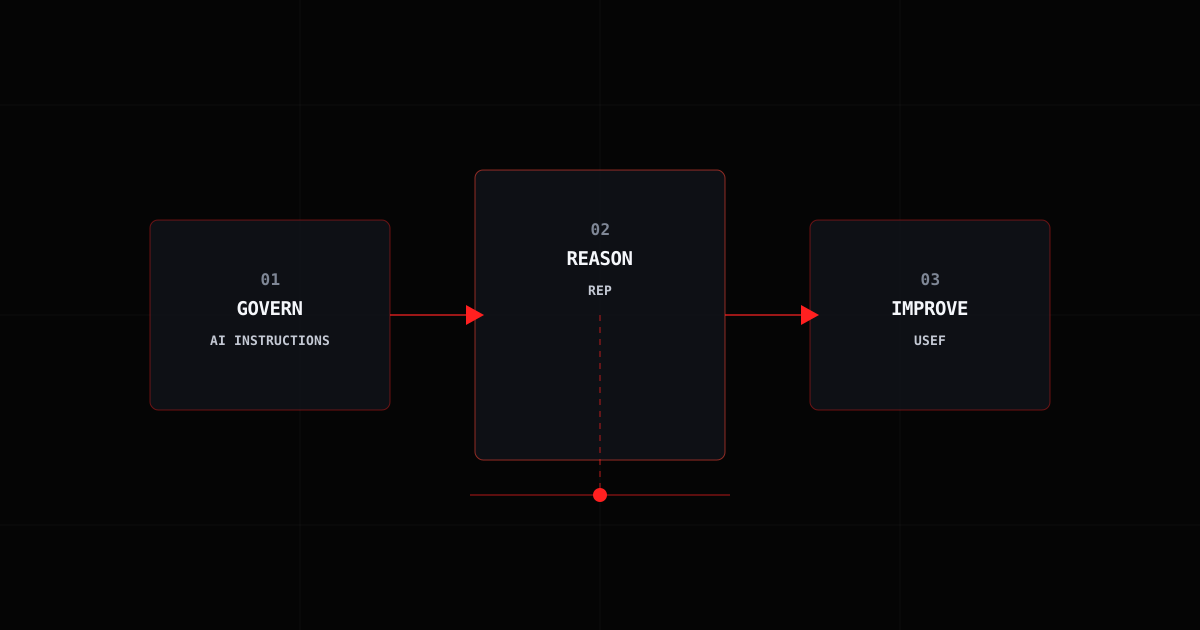
The three compose into one shape:
- AI Instructions defines the environment — what is allowed, required, and forbidden.
- REP defines the process — how conclusions are reached and checked.
- USEF defines the evolution — how both of the above improve from evidence.
Why this website takes a side
This site is not a neutral portfolio; it is the smallest system I know that demonstrates the thesis end to end. The organism in the MAGIC laboratory adapts its quality under load and stays legible while changing — coherence under change, the exact property the frameworks pursue at larger scale. The static architecture is will made structural: constraints I chose, enforced by validation that fails loudly, so the system cannot quietly drift away from the intention. The loading and motion design is measurement before decoration. Human idea, structured content, verification, build, static delivery — that pipeline is AI + Will + Systems with the rhetoric stripped off.
Three claims, then, as the current state of the programme:
- The model is necessary but not sufficient; the surrounding system carries most of what we call reliability. (Position, defended above)
- Reasoning that cannot be inspected cannot be trusted, only sampled. (Position, operationalised by REP)
- A system that cannot improve from its own failures is capped at the quality of its original design. (Position, enforced by USEF)
Capability is now the cheapest input in the equation. Direction and verification are where the work moved. Build accordingly.