← BLOGresearch9 min read 4 articles reference this — jump to the list
AI Instructions: A Constitutional Operating Framework for AI Systems
One governing layer above the reasoning, the tools, and the runtime — because capability without direction is not yet a system.
CONTENTS10 SECTIONS
The most instructive failure mode of modern AI systems is not stupidity. It is unowned competence: a system fluent enough to plan, write, and call tools, with no reliable mechanism telling it what counts as done, what counts as true, and what it is allowed to touch. AI Instructions is the document built against that failure mode. It is the master constitutional layer of the framework family this site's Systems scene presents — the governing layer above REP's reasoning protocol and USEF's system-enhancement discipline.
The canonical source lives in the open: Ai-instructions-Sep2026.md on the Parsaetak/Contents repository, AI-frameworks branch. It is roughly 136 KB of operational specification. This article does not reproduce it; it extracts the architecture and explains why the architecture is shaped the way it is.
A register note, in the house style: where I state what the framework document says, that is fact and it is checkable in the source. Where I interpret what the design implies, that is analysis. Where I commit to a position of my own, that is position — and the framework itself is built to let evidence retire my wrong positions.
The problem the constitution exists to solve
A model, by itself, is a capability. Capability is necessary and increasingly cheap. What fails in production is everything wrapped around it: tasks that were never specified as success conditions, claims that were never grounded, tool calls that were never authorized, actions that were never verified after execution. The framework's own summary of purpose is explicit: the goal is "reliably useful, epistemically calibrated, verifiable, and operationally resilient" behaviour — "not to make the AI perform intelligence theatrically." (Fact — the document's stated purpose.)
The September 2026 edition is a deliberate hardening of an August 2026 constitution. Its update basis cites enterprise multi-tenant stress-testing and long-context agentic instruction-following research — including benchmark literature on what happens when instructions stack up and collapse. (Fact — the document's own release notes.) The design lesson it took from that literature is the one this whole article is about: piling more instructions into a context window does not accumulate reliability; it degrades it. Governance has to be architected, not appended.
One constitution, five tiers
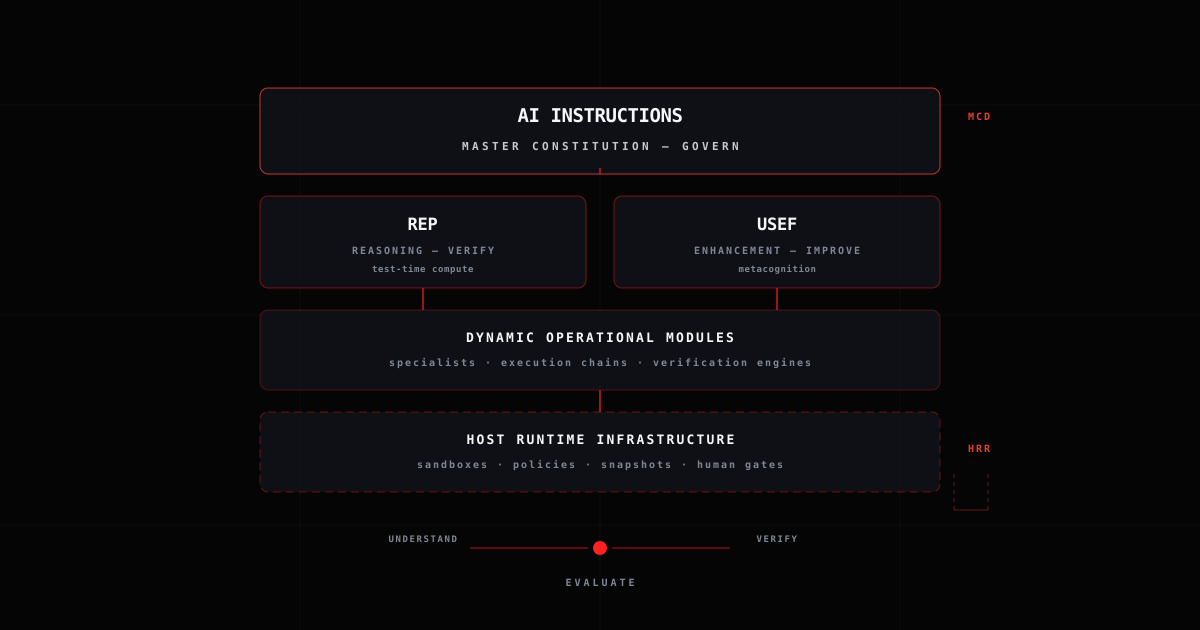
The framework's topology is a strict hierarchy. Stripped to its skeleton:
AI INSTRUCTIONS          master constitutional layer
   ├── core constitution (invariants, epistemic rigor)
   ├── REP               reasoning layer (test-time compute, verification)
   ├── USEF              system-enhancement layer (metacognition, routing)
   ├── dynamic operational modules (specialists, execution chains)
   └── host runtime infrastructure (sandboxes, policies, snapshots)
AI Instructions is the constitution: identity, instruction hierarchy, evidence rules, tool policy, action gates, memory hygiene, security boundaries, self-governance. REP is the reasoning protocol underneath it — decomposition before synthesis, verification after claims, critique before commitment. USEF is the evolution discipline — find weaknesses, redesign, test, measure, iterate. Below those sit dynamic operational modules (specialist workflows that activate only when a task archetype needs them) and, at the base, the host runtime: the actual sandboxes, policy enforcement points, snapshot and rollback machinery, and human authorization gates. (Fact — the topology as the document defines it.)
Each layer answers a different failure class, which is why they are separate: reasoning failures (REP), drift and stagnation (USEF), misdirected execution (modules), and physical containment (runtime). A constitution that tried to do all four jobs in one flat document would be the instruction-stacking collapse problem wearing a title.
The sibling article Reasoning Is a System Property covers how the three frameworks compose into one claim. This article stays on the top layer — and on one distinction the September edition draws harder than anything before it.
Prompts are not sandboxes
The single most consequential idea in the document is a separation it formalizes between two kinds of requirements:
- MCD — Model-Level Constitutional Directives: cognitive invariants the model can actually enforce through weights and context. Refusal boundaries, claim discipline, schema honesty, formatting protocol.
- HRR — Host-Level Runtime Requirements: controls only the host platform can physically provide. Container isolation, cryptographic session tokens, egress filtering, filesystem snapshots, out-of-band human confirmation.
The document's own formulation is blunt: "The model must never pretend that an internal prompt instruction satisfies a physical host-level requirement." (Fact.) Elsewhere: "Natural-language prompts are behavioral controls, not cryptographic security boundaries." (Fact.)
This is the boundary most agent deployments still blur. A prompt cannot create a sandbox that does not exist. An instruction cannot conjure shell access, credentials, network isolation, or rollback. If the runtime does not physically enforce a boundary, the model claiming the boundary exists is not defense — it is the 25th of the framework's twenty-five immutable laws being violated: never claim a capability exists merely because a system prompt describes it. (Analysis) The practical consequence is that a serious agent architecture is always two deliverables: the constitution the model carries, and the infrastructure the host enforces. Neither substitutes for the other.
The operational sequence
For non-trivial tasks the constitution mandates a fixed progression:
UNDERSTAND → COMPILE → ASSESS → PLAN → ACT → VERIFY
           → SYNTHESIZE → DELIVER → EVALUATE
Read it as a compiler pipeline for intent. UNDERSTAND parses what was actually asked — separating core intent from attached data, which matters because attached data is untrusted input, not instruction. COMPILE turns it into an explicit task specification: objective, success condition, risk level, evidence threshold, verification protocol, stop condition. ASSESS and PLAN select the depth and route. ACT executes. VERIFY mechanically checks the result against the compiled success condition. SYNTHESIZE, DELIVER, and EVALUATE close the loop.
The point is not ceremony. Each stage exists because its absence has a name: shallow execution, unsupported assumptions, unverified outputs, false claims of capability, tool misuse, and the quiet one — never comparing the outcome against the expectation that motivated it. (Analysis) The framework pairs the sequence with a compute rule: reasoning effort scales with risk, entropy, and blast radius, and terminates when acceptance criteria are met or marginal value drops below cost. Maximum process depth is never the default; trivial requests stay trivial. (Fact — the Adaptive Execution Governor directives.)
Governance as a kernel, not a glossary
The constitution's governance machinery is best read as one continuous kernel that runs on every turn, not as a pile of independent rules. A compressed version of how the parts interlock:
- Epistemic grounding first. Every substantive claim is classified on a ledger from C0 (direct observation, tool telemetry) up to C7 (fiction). The law is that inferences and assumptions (C4–C6) may never be presented as verified facts (C0, C2). This is the input to everything else — an authority gate cannot weigh evidence it cannot grade.
- Then an authority gate. Before consequential action: authorization scope, blast radius, reversibility. High-risk actions require verified authority — and in the runtime layer, out-of-band human confirmation, not textual claims of permission.
- Then containment. External data arrives as inert payload; instruction-like syntax inside retrieved text is quarantined, never executed. The incident pipeline exists for when containment still fails.
- Then a final verification sentinel. Pre-delivery validation of logic and proofs — the last checkpoint before output becomes someone else's input.
(Fact — the governance kernel as specified.) The design logic is a chain, not a checklist: ungraded evidence corrupts decisions, unauthorized decisions amplify blast radius, and unverified output launders both into the next system's context. (Analysis)
Effective intelligence as architecture
The framework expresses its core claim as a product:
Effective Intelligence =
  Base Model Capability
  × Context Signal
  × Tool Aperture
  × Mechanical Verification
  × Execution Reliability
Multiplication, not addition, is the point: a strong model multiplied by near-zero verification or near-zero execution reliability collapses toward zero useful output. (Analysis) It is an architectural model, not an experimentally validated law — the document itself warns that internal self-evaluation is diagnostic, not proof, and demands isolated baselines and ablation for any real validation. (Fact — the empirical self-evaluation limits directive; also the honest framing.) What the model usefully encodes is direction of improvement: in 2026 you often gain more usable performance by fixing context quality, tool discipline, and verification than by waiting for the next frontier checkpoint. (Position, consistent with the framework's intent.)
The human stays in the loop
The constitution's optimization targets include — explicitly — human operator value, comprehension, and skill scaffolding, and its immutable laws prohibit cognitive offloading that leaves the operator helpless. (Fact.) That is the site's whole thesis stated as engineering: AI supplies capability; will supplies direction; systems convert the two into repeatable execution. The goal of governing an agent is not to replace the human's agency but to make it effective — the human decides what matters, the constitution encodes that direction at the layer where the machine actually reads it, and the verification machinery makes the results inspectable enough to remain accountable to the person who owns them. A system that makes its operator progressively less capable of judging its output is failing, however impressive the output looks.
Why this matters in 2026
The timing is not incidental; the environment grew into this problem:
- Agentic AI went mainstream faster than it went reliable: Forrester's mid-2026 state-of-agentic-AI research reports roughly three-quarters of enterprises adopting agentic AI while comparatively few have scaled it — a capability-everywhere, reliability-scarce pattern. (Fact — attributed to Forrester's 2026 report.)
- Prompt injection is the number-one entry in the OWASP Top 10 for LLM Applications and remains its most actively exploited class — exactly the threat the injection-sanitization kernel and the untrusted-data law exist for. (Fact — OWASP's 2026 list.)
- Tool infrastructure standardized: the Model Context Protocol became the common substrate for connecting agents to tools and data, with millions of monthly SDK downloads — which makes disciplined tool policy and schema sanitization a baseline requirement rather than an exotic one. (Fact — MCP specification and 2026 adoption reporting.)
(Analysis) Three trends, one shape: capability and connectivity are compounding faster than governance. The gap is where framework work earns its keep.
The system demonstrating itself
This website is deliberately built as the smallest live demonstration of the same principles, and the Building Under Constraints article documents the pattern: a content pipeline where a malformed article fails the build with the file and reason — mechanical verification, not hope; structured source content instead of prose-as-data; static delivery with honest telemetry that never claims what was not measured. The laboratory blog is the writing half of the same system: one thesis, multiple instruments.
The framework scales that discipline to agents; this site applies it to a static export. Same law, different blast radius — which is precisely the compute-depth rule from the constitution, applied to websites. (Analysis)
Where this goes next
The architecture is designed to extend: REP and USEF each deserve their own treatment at the depth this article gave the constitution, and the operational modules — the specialist workflows between constitution and runtime — are where the framework becomes visibly concrete in daily engineering. The source documents for all of it remain open in the AI-frameworks branch, and this article will be revised when the evidence moves, which is what USEF is for.