← BLOGresearch4 min read
Red Theory and the Living Web
Emergence, adaptation, competition, dissolution, replacement — five dynamics, tested on the web itself.
CONTENTS3 SECTIONS
The Work scene of this site describes RED THEORY as an experimental model for emergence, adaptation, competition, dissolution, and replacement. That is a deliberately compact sentence for the idea doing the most work in this laboratory: that behaviour — not structure — is what makes a system alive, and that the five dynamics above are the minimal vocabulary of that behaviour. This article unpacks the model, shows where it is already running in code you can read, and marks the boundary between what is demonstrated and what is not.
The five dynamics
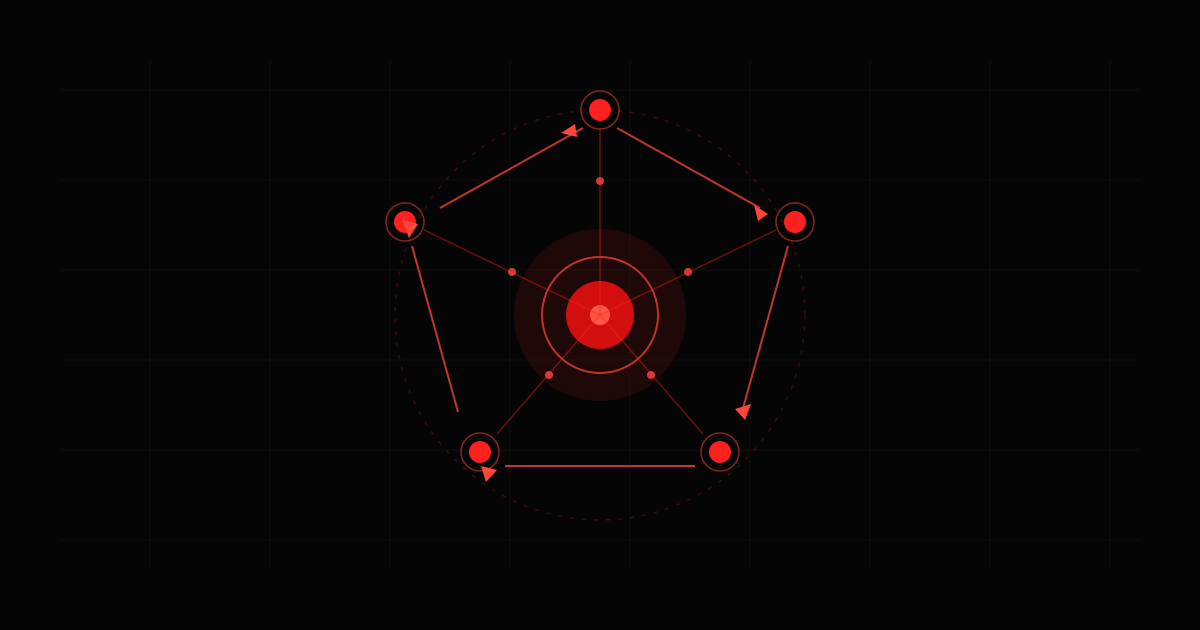
RED THEORY treats any persistent system — an organism, a codebase, a market, a website — as a population of processes competing for a shared resource budget. Five dynamics describe its life:
- Emergence — structure appears from interaction, not from blueprint. The whole is a consequence of local rules, not a designed artefact.
- Adaptation — processes that survive are the ones that reshape themselves under pressure. Adaptation is continuous, not an event.
- Competition — processes contend for the same finite budget: attention, energy, memory, frames.
- Dissolution — what stops earning its budget is dismantled and its resources are recycled. Nothing is sacred.
- Replacement — freed resources are re-invested in what the current environment rewards, and the cycle runs again.
The ordering matters. The dynamics are not a lifecycle with an end state; they are a loop. A system that only adapts accumulates cruft. A system that only replaces loses its identity. The model claims the five running together, continuously, are what distinguish a living system from a decorated one. (Position — this is the model's core claim, stated as such.)
The test bench is this website
A model of living systems needs an observable instance. Building a separate simulator before having any real substrate to check it against would have produced exactly the kind of unfalsifiable artefact the reasoning frameworks exist to prevent. So the website itself became the test bench, and the mapping is concrete:
- Emergence — the ambient organism in WorldBackground is a set of layered loops with independent timescales and de-synchronised phases; the visible "breathing" field is what those local rules produce together, not an animation anyone drew frame by frame. (Fact — the implementation is in this repository.)
- Adaptation — the RED MAGIC engine measures the display it runs on and reshapes its own quality tier under sustained pressure, demoting and promoting itself against the measured refresh rate rather than a mythical constant. (Fact — the quality governor is in the engine; the reasoning is documented in The Anatomy of a Fast Static Site.)
- Competition — every animated layer contends for the same frame budget. The engine's particle, membrane, and signal layers are explicitly budgeted; when the budget tightens, peripheral layers lose resources first. (Fact.)
- Dissolution — organism state decays to silence at zero JavaScript cost when interaction stops; the living-system article documents the settle-to-idle behaviour as a designed property, not an accident. (Fact.)
- Replacement — the September 2026 editions of the site's articles replaced earlier positions wholesale; the organism's layers were rebuilt around de-synchronised phases in v2.2, replacing the older synchronised field rather than incrementally patching it. (Fact — see this repository's history.)
(Analysis) the interesting property of this mapping is that the dynamics were not added to the site as illustrations. The site was engineered for honesty and performance, and the dynamics fell out of doing that engineering properly — which is the model's own thesis about emergence, applied to itself.
The honest boundary
RED THEORY's public footprint today is exactly two things: the model statement (the Work scene description and this article), and the demonstrated instance (this repository — background, engine, and document history). There is no standalone public simulation repository for RED THEORY, and this article does not claim one. (Fact.) The measurement discipline described in Measuring Machine Intelligence exists precisely so that claims about systems — including this one — stay pinned to instruments rather than enthusiasm.
(Position) the next stage of RED THEORY is to move from a demonstrated instance to a formalised, testable model — the same progression the governance frameworks followed from constitution to specification. The site will document that progression as it happens, with the same separation of fact, analysis, and position used here.
A living system is not one that never stops changing. It is one whose changing is accountable — every dynamic observable, every claim checkable, every replacement recorded. That standard is the theory, and the site is where it earns its name.